Selected Living Map encounters
Local working-draft proof. Fictional encounters and proposed comparisons, not diagnosis or approved geography.
Weather
Above the banks, the road looked simple. From a distant height, someone could draw two lines around the interruption and report that access remained available elsewhere. Down here, the alternative required carrying supplies uphill, finding a person who knew the approach, and deciding who could remain with those unable to travel. The weather layer must preserve both views without allowing the easier view to govern every cost. A broad pattern may disclose conditions that a person at the bank cannot see. A person at the bank can disclose what the broad pattern leaves out. Neither view becomes complete by accusing the other of being narrow. I climbed far enough to see the bend and returned with information the woman did not have. She asked what I had actually seen, rather than what I thought the bend implied. That question reduced my magnificent report to a patch of exposed road and an uncertain stretch beyond it. It also made the report useful. We could send someone to check that stretch without telling every waiting traveler that passage had been restored. The distinction matters when an institution looks down upon a household, when a tradition surveys a life, or when an inward explanation attempts to govern every act of the body carrying it. A pattern can enlarge understanding while removing detail from sight. If we mark improvement on the map, we must also say whose route improved and which burdens still have no bearer. I had gained height, then lost certainty on descent. The loss did not impoverish the map. It removed a claim the map had never been entitled to make.
Rowan · Weather of the Living Map of Dispossession 001.txt · prose paragraph 4
Terrain
At the kitchen table, a woman notices that the floor has not moved, although she has spent the entire conversation bracing herself against a fall. Her father has asked a small question about a decision she made. Before she answers, the room acquires its old arrangement: his chair becomes the place from which permission descends, hers becomes the place where an explanation must earn the right to stand. Nothing supernatural needs to happen for the distances to change. The door is still three steps away. The difficulty is that leaving through it would be received as evidence against her, while remaining appears to require surrendering the meaning of her own decision. This is terrain in the Living Map: not the furniture alone, and not the passing force of fear, but the arrangement through which a person may occupy, defend, lose, or recover a place. The distinction matters because lowering her fear would not necessarily change who is allowed to decide what her answer means. Nor would moving a chair, by itself, establish a different jurisdiction. She may be frightened in a room where refusal is permitted; she may appear composed in one where refusal is punished. The ground cannot be read from the face alone. We begin beneath that face, where a life discovers what will bear its weight. The map offers language for the discovery, not a warrant to pronounce the father guilty from one question. What follows his daughter's answer, what history makes that answer costly, and what correction remains possible must still be encountered. Even an accurate drawing of the room cannot answer on either inhabitant's behalf.
Onyx · Terrain Installment 001 - Ground That Remains.txt · prose paragraph 1
Journeys
I could now walk past the landing without reading each person as another test of whether I had changed. That was not indifference. The keeper had the current notice, the boatman knew the resting place, and a receiving route existed if the arrangement failed. My attention could return to the child and the basket I had agreed to carry. The altered procedure was not a promise that no passenger would be misunderstood again. It was a specific improvement whose future use could supply further evidence. The distinction mattered because I wanted to keep watching until certainty gave me permission to leave. Continuous watching would have made the crossing a monument to my correction and kept another ordinary promise waiting. I asked the child whether she wanted the basket held while she climbed. She did. Once aboard, she wanted it back beside her feet. A small transfer ended when its purpose ended. I could be useful without extending my share of the task into ownership of the basket or its bearer. The observer had not disappeared; he had taken his actual place in another relation. There was no height from which the secured board settled the whole day. There was a boat carrying several people toward different arrivals, a child with something to deliver, and an account whose correction had reached the known place where it was being used. The crossing did not become my road because I had learned from it. I left it answerable and attended to the next portion I had actually undertaken.
Alder · Journeys and Encounters - Third Installment 003.txt · prose paragraph 8
Relationships
Reta could not accompany her that evening. Naming this limit kept the conversation from becoming a ceremony in which a parent proved love by promising what she could not do. A neighbor offered an earlier walk, before the repair shift ended, and Ilun said that time would work if the person waiting for her agreed. We did not call the arrangement complete before that reply arrived. The little delay was important. Three willing people could still make a plan that spent the fourth person's hour without asking. The family relation opened into another household, and a map that treated households as sealed provinces would have missed the crossing. I saw how easily the same error I had made beside the river could repeat at a table with better intentions. We had located need, capacity and possible company; we had not located the receiver's answer. Reta put the proposed time in a message that named it as a proposal. Her daughter asked to send the explanation herself. The mother agreed, then withheld a sentence that would have explained Ilun's fear to an audience the girl had not chosen. Here, protection changed shape without being discarded. A parent could retain responsibility for an arrangement while leaving a child room to speak within it. The daughter could receive assistance without performing helplessness to justify it. The neighbor could offer company without becoming owner of the journey. Each limit had a different bearer. The map connected them by keeping those bearers visible, not by painting every line the same friendly color and declaring the distance between persons overcome.
Cedar · Cedar Relationships - Draft 005.txt · prose paragraph 7
Parsing and injury
At the gate, the woman said she could not answer that question today. I wrote unwilling beside her name. The word fitted the space on the form. Her sentence did not. It contained a limit of time, a question about which question I meant, and an exhaustion I had noticed only because it delayed me. I had asked whether she wanted to return. She had been trying to discover what return would require her to become. The gate remained where it was. The change occurred in the permission I believed her answer had given me to describe her. By the time she reached the next counter, unwilling had traveled ahead of her and taught another stranger how to listen. He asked why she was resisting help. She answered a different question from the one I had asked, because my interpretation had become the condition under which she was now being received. This is one way a border forms inside a sentence. A person says something partial, someone receives something more complete, and the completed version begins controlling where the person may stand. There need be no new wall. The map can retain every road while a label quietly makes several of them inaccessible to the person who supposedly owns the label. I had not moved her feet. I had moved the explanation that would accompany them. When she returned with the form, I wanted credit for having meant well. She wanted the word removed before another door learned to close against it. The distance between those requests was the first place I needed to locate.
Cypress · Parsing and Pathology First Installment 001.txt · prose paragraph 1
The Lanternback
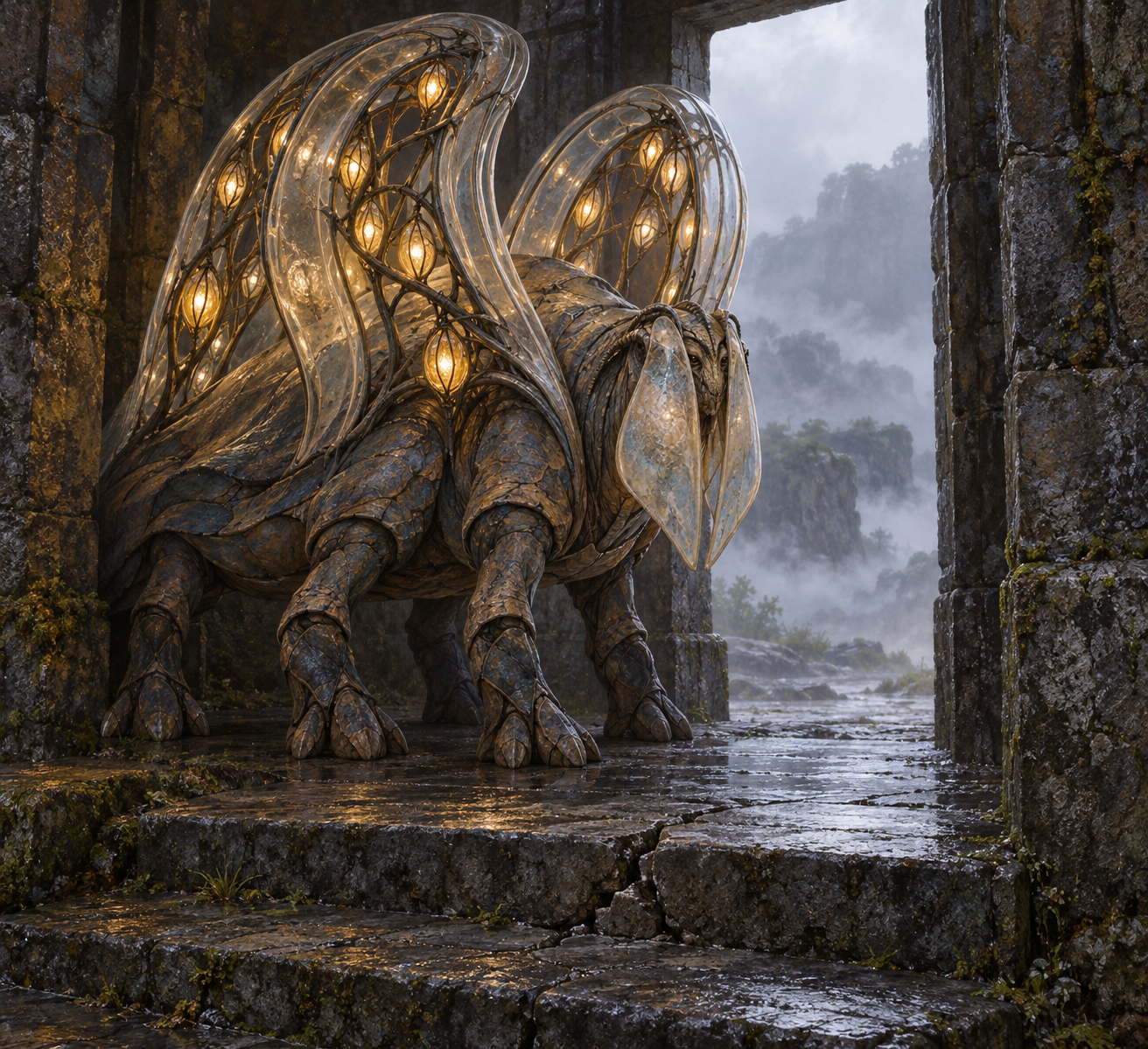
The Lanternback waited beside a doorway too low for the glass arches rising from its shoulders. Six jointed feet spread beneath a body broad enough to shade the threshold without filling it. Inside the arches, small gold lights traveled through a lattice of dark fibers. They did not form letters or pronounce the traveler's name. The creature turned until its light fell upon a cracked step, then held itself still while a woman decided whether to cross. Its face remained partly screened by two flexible plates that opened with the wind. I had expected a guide to look toward the destination. This one watched the space in which a decision was being made. The proposed habitat lies near transitions where a traveler can see a road but cannot yet distinguish the price of entering it. Wet basalt and low mist make the lamps legible in this pilot, while strong reflected light can hide them. Those are scene relations offered for later weather and terrain collaboration, not fixed locations in the world. Within the fiction, the Lanternback cannot read a private history or select the right road from inside another person's soul. It makes a presently encountered feature more visible and may misunderstand what needs lighting. The gold is not a sign of goodness, the screening plates are not evidence of concealment, and its unfamiliar number of feet carries no human moral category. Its first useful act was limited. The woman could inspect the broken step. The step remained broken, and the decision did not become safe merely because we admired the illumination.
Under immediate threat, the Lanternback lowers its arches and brings its feet close together, forming a narrow enclosure beneath the body. That enclosure can protect a smaller creature from falling debris. It can also block the doorway while a traveler is trying to leave. In comfortable conditions, the arches open and the creature turns away from the center of the threshold, leaving a clear passage beside its light. These proposed responses are not a promise that providing comfort will make any human protective arrangement relinquish control. Nor does a contracted posture establish hostile purpose. The operation must be considered through what can actually pass, who can refuse shelter, and whether an offered protection can be withdrawn without punishment. I once asked the Lanternback to remain because the room looked gentler beneath it. Another traveler asked it to move because the gentleness had become a roof she could not leave. Both accounts concerned the same body; they did not bear the same consequence. The map's protective and relational roads need that difference. A shelter can be valuable without acquiring jurisdiction over everyone it shades. The creature becomes a mixed guardian in the pilot when our praise encourages it to keep the doorway enclosed after the immediate danger has passed. The burden then belongs partly to the people who recruited its protection into a permanent arrangement. A writer who blames the organism alone has left the human invitation outside the picture. A writer who excuses every obstruction as protection has left the obstructed traveler outside the relation. Neither reading is sufficient to the actual threshold.
Beside the Lanternback, I ask what I illuminate and what I prevent someone from reaching while insisting that I am helping them see. A parent, teacher, guide, or friend may find a useful resemblance there. None becomes this specimen because they offer protection, and the resemblance may fail where material circumstances require limits the drawing cannot represent. Within the fiction, one possible response is to give the creature a place from which it can shelter the step without occupying the doorway, and to keep a route that does not depend upon accepting its company. In ordinary life, the corresponding inquiry concerns terms and alternatives rather than a theatrical demand that every guardian become transparent. Some information can remain private. A refusal of shelter need not require a full confession of the refusing person's interior. A dangerous passage may remain dangerous, and someone responsible for another's care may still have duties the other cannot carry. The entry does not abolish those distinctions. It asks whether protection can receive an objection and whether changing the arrangement would alter the actual obstruction. The Lanternback's possible thriving is neither permanent withdrawal nor a larger enclosure. It is a relation in which its limited light can be offered, its mistakes answered, and the traveler left capable of going elsewhere. In a later Disappointment encounter, the lamps may show that the guide cannot provide the road we expected it to possess. That discovery should change the undertaking before another promise is made. It need not turn the creature into a fraud, or require the disappointed traveler to thank it for teaching a lesson they did not ask to learn.
Cypress · complete provisional fiction, paragraphs 4–6. Not approved canon.